

Anyone who has spent five minutes shopping for a dish rack knows the standoff: mount one over the sink to save counter space, or set a freestanding one on the counter for room to breathe. Both promise a tidier kitchen. Only one holds up when you stack it with a Dutch oven, three dinner plates, and a fistful of cutlery at once.
We put both formats through a hands-on evaluation to settle the question with something better than opinion. The short version: for the vast majority of households, the countertop model earns its keep. Here is how we got there, and where the exceptions actually live.
Quick Verdict: Our Testing Snapshot
Winner: Countertop dish drainer. Across our benchmarks it delivered steadier footing, noticeably higher load capacity, and far more flexibility in where and how you use it. The over sink dish drying rack has a real niche, but it loses ground the moment your kitchen has to handle a normal day's worth of dishes.
Rating Breakdown at a Glance
| Criterion | Over Sink Rack | Countertop Drainer |
|---|---|---|
| Water drainage efficiency | 9 / 10 | 8 / 10 |
| Load capacity | 5 / 10 | 9 / 10 |
| Build quality & durability | 6 / 10 | 9 / 10 |
| Ease of use / installation | 6 / 10 | 9 / 10 |
| Stability & safety | 5 / 10 | 9 / 10 |
The over sink option wins one category outright, drainage, because gravity does the work straight into the basin. Everywhere else, the countertop format pulls ahead.
How We Evaluated Each Dish Rack Type
A verdict is only as trustworthy as the process behind it. We anchored our assessment to repeatable tests rather than gut feel, so the scoring above reflects observed behavior instead of marketing copy.
Testing Criteria and Scoring Method
Five benchmarks carried the evaluation. Water drainage efficiency measured how quickly a loaded rack shed standing water. Load capacity tracked the weight and volume each frame held before flexing or tipping.
Build quality looked at weld points, coating adhesion, and material gauge. Installation effort covered setup time and fit tolerance. Cleaning ease rounded things out, since the rack that traps grime fastest is the one you replace soonest.
Materials and Models Considered
We compared frames across the common price tiers: brushed 304 stainless steel dish rack builds, silicone-coated steel roll-up dish drying rack styles that lay across the sink, and standard plastic-coated wire frames. Stainless and roll-up designs appear in both over-sink and countertop configurations, which let us isolate format from material and judge each fairly.

Understanding the Over Sink Dish Drying Rack
The over sink dish drying rack is the minimalist's default. It bridges the basin so the sink itself becomes the drainage zone, and it has a loyal following in apartments where counter real estate is measured in inches.
How It Works
The frame rests on the sink's two opposing edges or clamps to the rim. Dishes sit above the basin, and water drips straight down the drain with no tray to empty. It is elegant in theory: the mess never touches your counter.
Pros of Over Sink Racks
Zero counter footprint. Your usable prep surface stays completely clear.
Direct drainage. No reservoir means no puddle to wipe and no tray to rinse.
Genuine fit for micro-kitchens. In a galley setup where the counter is already crowded, this format solves a real problem.
Cons of Over Sink Racks
The tradeoffs show up quickly in daily use. Sink dimensions vary wildly, and a rack sized for a 33-inch basin sags or slips on a 30-inch one. Fit tolerance is the single biggest complaint we encountered.
Using the rack also blocks the sink beneath it, so washing and drying can't happen at the same time. Many suspended models carried a modest weight ceiling, roughly 5 to 8 kilograms in the units we handled, and wobble crept in well before that limit when the load was uneven.
Understanding the Countertop Dish Drainer
The countertop dish drainer is the format most kitchens grew up with, and its staying power is not an accident. It trades a slice of counter space for stability and capacity that the suspended design can't match.
How It Works
It stands on its own beside the sink. You get a self-contained drying station that works regardless of your sink's shape.
Pros of Countertop Racks
Superior stability. Four feet on a flat surface simply don't wobble the way a bridged frame does.
Higher capacity. The sturdiest units in our group held 12 kilograms and up without flexing.
Flexible placement. Move it to the counter, the island, or a drying mat wherever it suits the moment.
Wider material and size range. From compact single-tier trays to two-level expandable frames.
Better long-term durability. Fewer stress points mean fewer failure points over years of use.
Cons of Countertop Racks
The honest downside is counter space. A traditional frame parks itself on your prep zone and stays there.
That concern is largely solved by modern design, though. The tradeoff that once defined this category is now optional.
Head-to-Head: Over Sink vs Countertop Compared
Here is where the two formats meet on each benchmark, criterion by criterion.
Capacity and Everyday Practicality
This is where the gap widens most. Over sink racks handle plates and cups fine but struggle the moment a stockpot or cast-iron skillet enters the picture. Countertop drainers absorb the awkward, heavy items, mixing bowls, sheet pans, pot lids, that a suspended frame can't safely balance. For a family kitchen after dinner, that difference is felt every single night.
Stability and Safety
A rack on a flat counter distributes weight through its base. A rack spanning a sink relies on two contact edges and the friction at each end. Under an uneven load, the suspended design shifts, and shifting racks are how glasses end up in pieces at the bottom of the basin. Lower breakage risk is a quiet but real advantage of the countertop format.
Durability and Material Quality
Material matters more than format for longevity, and the top performer in both camps was 304-grade stainless steel. A stainless steel dish rack resists the rust and coating chips that plague plastic-coated wire once moisture works into a scratch. If you want a frame that still looks respectable after several years of daily soaking, stainless is the investment that pays off.
Installation and Maintenance
Over sink racks demand a measuring tape and some luck with your basin's dimensions. Countertop drainers are plug-and-use: unbox, set it down, done. Maintenance also favors the countertop tray, which lifts out for a quick rinse, whereas some fixed over-sink frames are fiddly to clean around the mounting points.
Who Should Choose Which?
Format should follow your kitchen, not a blanket rule. Here is the honest split.
When an Over Sink Rack Makes Sense
If your counter is genuinely at capacity in a studio or tiny galley kitchen, or if you run a dual-sink setup where one basin can stay permanently dedicated to drying, the over sink dish drying rack is a smart, purpose-built choice. In those specific layouts, it does exactly what nothing else can.
Why Most Kitchens Are Better Off with a Countertop Rack
For everyone else, the countertop dish drainer wins on the strength of its combined benefits. It handles a real dish load, stays put under weight, fits any sink, and, in foldable form, stows away when you want your counter back. That balance is why it remains the default recommendation for the average household.
Buying Guide: Choosing the Right Countertop Dish Rack
Once you're leaning countertop, a few features separate a rack you'll keep from one you'll curse.
Key Features to Prioritize
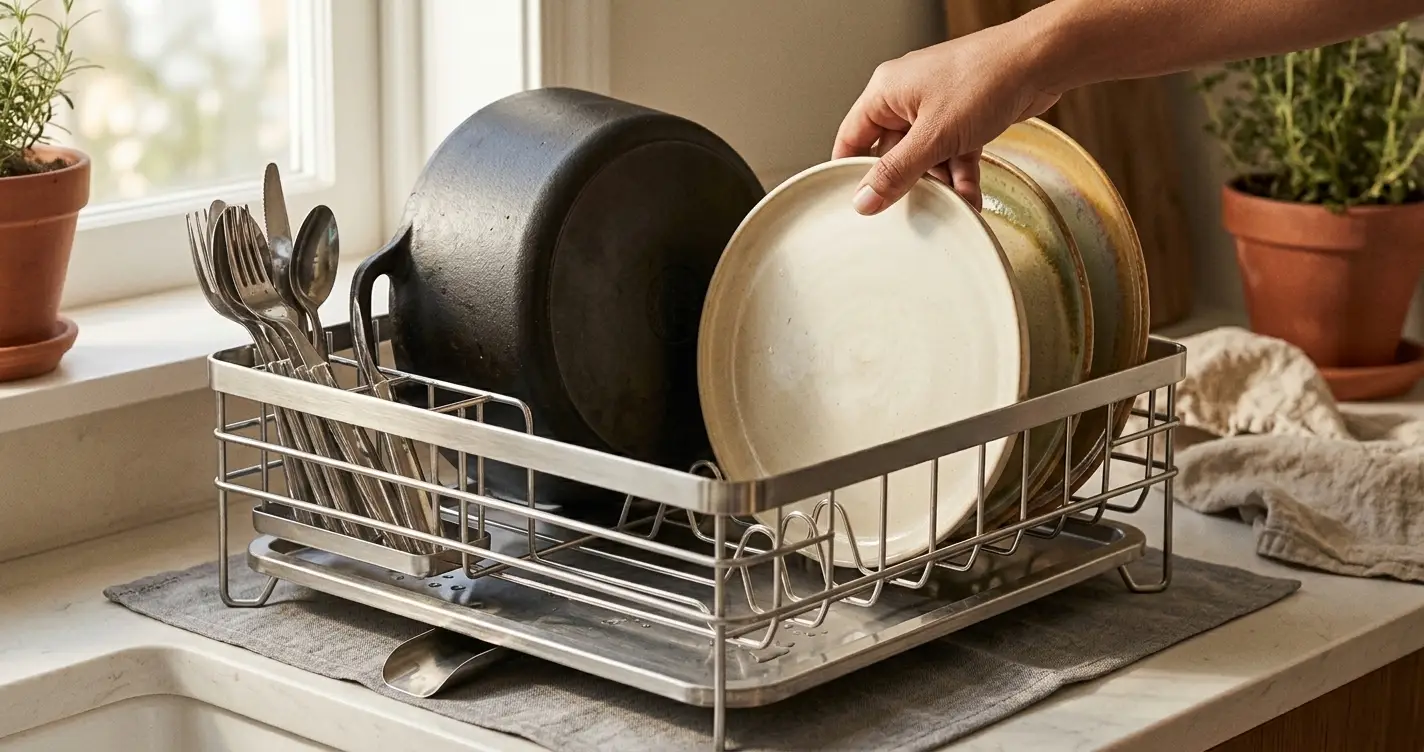
Removable drip tray. A classic rack with a slide-out tray catches runoff and lets you empty it into the sink, so no directional spout is needed and water never pools on the counter.
Material grade. Look specifically for 304 stainless steel rather than an unspecified "stainless" label, which often means a thinner, rust-prone alloy.
Sturdy fixed frame. A solid, non-collapsing design holds its shape under a full load and stays stable through daily use, unlike roll-up mats or flimsy folding frames.
Size and Layout Considerations
Measure the clear counter run beside your sink before buying. A single-tier drainer suits compact kitchens, while a two-tier or over-the-counter cutlery-integrated model earns its space in busier households. Match the rack to the counter you actually have, not the kitchen you wish you had.
Final Verdict: The Countertop Dish Rack Advantage
Both formats have a legitimate place, but the evidence points one direction for most people. The over sink dish drying rack owns drainage and the narrow niche of ultra-tight or dual-sink kitchens.
The countertop dish drainer wins nearly everything else, capacity, stability, durability, and, thanks to foldable and roll-up designs, even the space-saving argument that used to be its weakness. For the average kitchen weighing real dish loads against real constraints, a well-built stainless steel countertop rack is the choice that keeps paying off long after the box is recycled.
Frequently Asked Questions
Q: Do Countertop Dish Racks Take Up Too Much Space?
A: Traditional frames do occupy the counter, but foldable and roll-up dish drying rack designs solve that entirely. They collapse flat or roll into a compact bundle after use, so the rack is only present when you're actually drying dishes.
Q: Are Over Sink Racks Better For Small Kitchens?
A: Sometimes, but not automatically. In an extremely tight kitchen an over sink rack can be the right call. For most small kitchens, though, a compact collapsible countertop model delivers the same space savings without the risk of a poor sink fit or blocked basin access.
Q: Which Material Lasts Longest?
A: A 304-grade stainless steel dish rack outlasts plastic-coated wire and painted finishes. It resists rust even where the surface gets scratched, which is exactly where cheaper coated racks begin to corrode.
Q: How Do I Keep A Dish Rack From Developing Mold Or Rust?
A: Empty and dry the drainage tray daily rather than letting water sit, since standing moisture is what breeds mold and pitting. Choose a design with an angled spout so runoff clears itself, and give the rack a periodic wash with warm soapy water to clear residue from the corners and joints.
Q: Can A Countertop Dish Drainer Handle Large Pots And Pans?
A: Yes, and this is one of its clearest advantages. A stable countertop frame supports stockpots, skillets, and sheet pans that a suspended over-sink rack can't safely balance without wobbling or exceeding its weight limit.
