

You wash the dishes. You rinse them properly. You set them on the rack to air-dry like a responsible adult. And somehow, a week later, you're staring at pink slime in the drip tray and wondering if your kitchen is trying to unionize against you.
If it's any comfort, this ranks among the most common (and least talked about) kitchen problems out there. The good news: once you understand what's actually growing on your rack and why, getting rid of it and keeping it gone is pretty straightforward.
Why Your Dish Rack Turns Into a Mold Farm Faster Than You'd Think
Mold isn't sneaky. It's boring, honestly. It shows up wherever four specific conditions collide, and a dish rack sitting on a kitchen counter is basically a five-star resort for spores.
The Four Things Mold Needs (And Your Rack Has All of Them)
Think of it as a recipe: moisture from wet dishes, warmth from the kitchen air, food particles left on plates and cutlery, and stagnant airflow inside crevices, joints, and drip trays. Give mold all four and you've built it a home.
Most people fixate on the moisture and forget about the food part. Even a rinsed plate carries microscopic starch and oil residue. That's the fuel. Water alone would just evaporate.
That Pink Slime Isn't Actually Mold - Here's What It Is
Here's a detail almost every article gets wrong. That salmon-pink or coral-colored gunk you keep scrubbing off the drip tray? Not mold. It's Serratia marcescens, a bacterium that thrives on soap residue and phosphates and loves damp bathroom and kitchen surfaces.
True mold looks fuzzy and shows up in colors like black, green, or grayish-white. Mildew is flatter, powdery, and usually starts as tiny surface spots before spreading. Bacterial biofilm (the pink stuff) is slimy and wipes off with pressure but returns within days if the surface stays damp.
Knowing which one you're dealing with actually matters, because they respond to slightly different cleaners. Vinegar handles biofilm easily. Entrenched mold sometimes needs stronger stuff.
Why Modern Kitchens Make It Worse
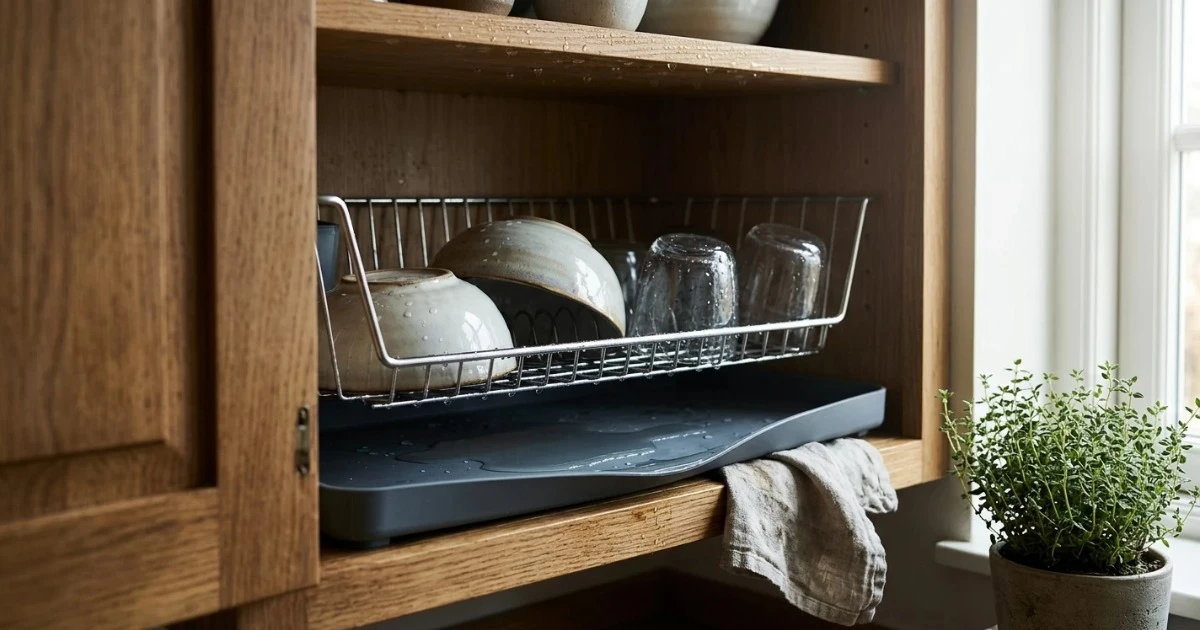
A few quieter culprits deserve a mention. Energy-efficient homes seal tighter, which is great for heating bills but terrible for humidity. Cabinet-enclosed drying areas (popular in some European kitchens) trap water vapor with almost no way out. Silicone drip trays with high walls hold puddles that never fully dry.
An EPA indoor air quality report from 2025 noted that average kitchen humidity in newer sealed apartments now runs about 15 to 20 percent higher than it did a decade ago. That's not a small shift. That's mold weather, indoors, year-round.
The Warning Signs Most People Miss
Not every rack announces its problem with a big black patch. Most of the time the signals are subtle, and by the time they're obvious you've been re-contaminating clean dishes for weeks.
Visual Clues on Different Rack Materials
Stainless Steel Racks
Look for rust spots along the welds, orange or brown staining near the base where water collects, and a slippery, almost oily residue in the drip tray. Stainless is called stainless for marketing reasons more than metallurgical ones. Cheaper grades absolutely rust.
Plastic and Silicone Racks
Cloudy discoloration is the first sign. Then come pink or black speckles in the seams, and eventually that unmistakable "wet sponge left in the sink for three days" smell. Silicone especially traps grime in its flex points.
Bamboo and Wood Racks
Dark grain lines running with the wood, softening or splintering at the joints, and fuzzy patches on the underside where you almost never look. Wood racks look beautiful for about six months, then quietly turn into a science experiment.
The Smell Test
If your just-washed dishes come off the rack smelling faintly sour, musty, or like a damp basement, the rack is contaminating them. This is one of the most common complaints in kitchenware reviews across Amazon and Wirecutter, and readers almost always blame the dishwasher first. It's rarely the dishwasher.
When Rust and Mold Team Up
Rust is worse than it looks because of what it does to the surface. Smooth metal is hard for mold spores to anchor onto. Rust creates a rough, porous texture that gives them thousands of tiny footholds. Once rust and mold occupy the same rack, cleaning gets exponentially harder because you can scrub the surface clean and still have colonies living inside the pits.
How to Actually Eliminate Mold and Mildew, Step by Step
Ranked from gentlest to most aggressive. Start with the mildest method that matches your situation, not the strongest.
Method 1: The Weekly Vinegar Soak
Mix one part white distilled vinegar (5 percent acidity) with three parts hot water in your sink or a large basin. Fully submerge the rack for 20 to 30 minutes, then scrub with a soft brush and rinse thoroughly.
Research published through the American Society for Microbiology found vinegar kills roughly 82 percent of common household mold species. Solid, but not everything. Treat it as your maintenance tool, not your nuclear option.
Safe on stainless steel, most plastics, and silicone. Skip it for untreated bamboo, which soaks up the acid and warps.
Method 2: Baking Soda Scrub for Stubborn Spots
Mix three tablespoons of baking soda with just enough water to form a thick paste. Apply directly to seams, corners, and the drip tray with an old toothbrush. Let it sit for 10 minutes, then scrub and rinse.
This is the method to use around kids and pets, or if anyone in the house reacts to chemical fumes. It also handles that slimy dish rack film vinegar sometimes leaves behind.
Method 3: Hydrogen Peroxide for the Serious Cases
For visible black mold or biofilm that keeps coming back, reach for 3 percent hydrogen peroxide, the standard drugstore kind. Spray it on undiluted, let it bubble for 10 to 15 minutes, then scrub and rinse.
One important note: don't mix peroxide with vinegar in the same cleaning session. Combined, they form peracetic acid, which isn't dangerous at these concentrations but can irritate eyes and lungs. Use one, rinse well, then switch if you need to.
Method 4: The Dishwasher Trick
If your rack is dishwasher-safe (check the manufacturer's guidance, especially for plastics), run it on the hottest cycle with heated dry on. Sustained heat above 150°F kills active mold and most bacteria in a way room-temperature cleaning never quite matches.
The catch: heat kills but doesn't remove. You still have to scrub off dead biofilm and staining. Think of the dishwasher as sterilization, not scrubbing.
What Not to Use
Bleach on stainless steel is a bad idea. It pits the surface, creates more spore-friendly texture, and voids most warranties. Oil-based soaps like Murphy's on plastic leave a residue that actually feeds bacteria over time. And those "natural" essential oil sprays with tea tree or lavender? They smell great. They do almost nothing to established mold colonies.
Preventing Mold From Coming Back
The scrub is the reset. Prevention is the boring stuff that keeps you from redoing it every three weeks.
The 60-Second Daily Habit
After the last load of dishes goes away for the night, wipe the rack and drip tray with a dry cloth, tilt the tray to drain any leftover water, and pull the rack a few inches away from the wall so air circulates around it. That's it. Almost nobody does this, and it's the single biggest reason mold keeps coming back.
Rearranging Your Kitchen for Better Airflow
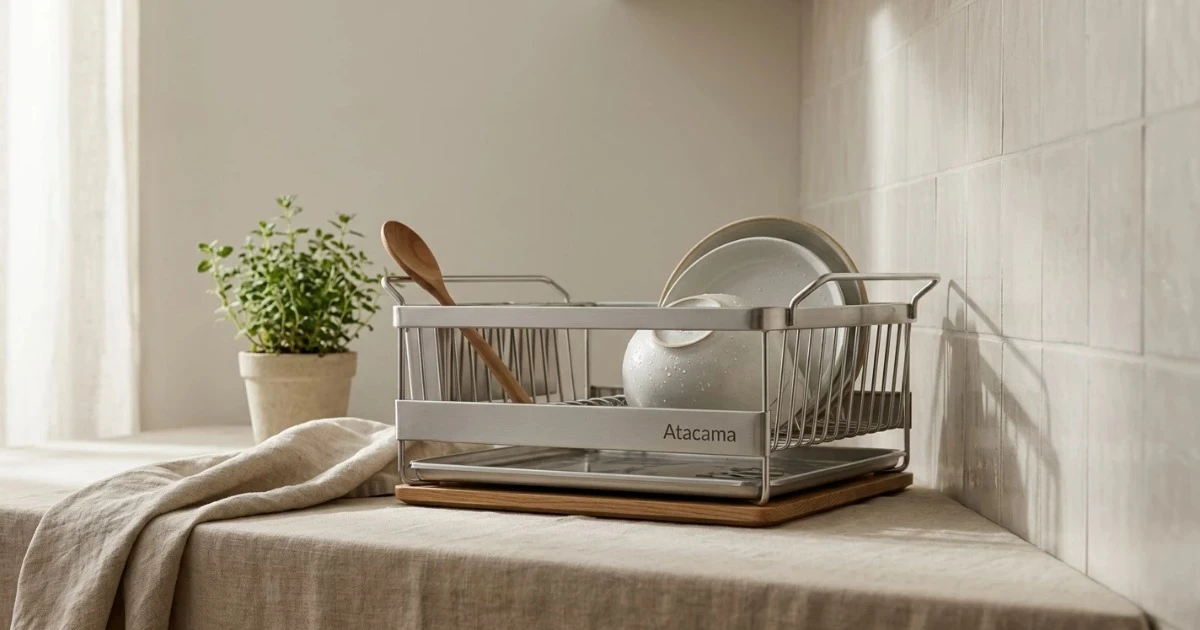
Move the rack out of enclosed cabinets and off wet countertops. If it sits directly on tile or laminate, slide a small trivet or wire stand underneath so air moves along the base. In tight kitchens, even a two-inch gap from the backsplash makes a measurable difference.
Choosing an Antimicrobial Dish Rack
The word "antimicrobial" on a product label usually means the plastic or coating is infused with silver ions or copper particles that disrupt bacterial cell walls. Real technology, but also heavily marketed by brands that haven't tested anything.
As of early 2026, only a handful of racks carry independent antimicrobial certification from third parties like NSF International. Certain Simplehuman and Joseph Joseph models are among them. Everything else claiming to be antimicrobial is running on manufacturer trust, which varies.
When to Just Replace the Rack
Some racks are past saving. Signs it's time to let go: deep rust that flakes when you scratch it, cracked plastic that traps water inside the wall, spongy or splintering bamboo, or mold that returns within days of a full soak.
A 30 dollar replacement beats weeks of re-scrubbing a rack that's already lost the war.
Real Kitchens, Real Fixes
The Apartment Renter With No Counter Space
A wall-mounted rack over the sink solves two problems at once. Water drips straight into the basin, so there's no drip tray to grow biofilm in, and gravity handles most of the drying without any effort. Steel models with a matte powder coating hold up best in small, humid apartments.
The Family of Five With a Constantly Wet Rack
Instead of buying one giant rack that never fully dries, use two smaller ones and rotate them. One is in use, the other dries completely between rounds. Sounds fussy, but it's genuinely why some households never deal with rack mildew and others fight it constantly.
The Bamboo Rack Lover Who Refuses to Give It Up
Once a month, wipe the whole rack down with food-grade mineral oil using a clean cloth. It seals the pores, repels water, and dramatically slows the softening and darkening that kills most bamboo racks by year two. Some owners get five or six years out of a rack this way instead of the usual eighteen months.
Frequently Asked Questions
Q: Is Dish Rack Mold Actually Dangerous?
A: For most healthy adults, occasional exposure is low-risk and your immune system handles it without you noticing. For people with asthma, mold allergies, or weakened immune systems, it's worth taking seriously. The CDC's general guidance on household mold applies here: reduce exposure, clean promptly, and don't ignore recurring growth in the same spot.
Q: How Often Should I Deep-Clean My Dish Rack?
A: A light wipe-down daily, a full vinegar soak once a week, and a thorough scrub with baking soda or peroxide once a month. If you live in a humid climate or a sealed apartment, bump the weekly soak up to twice a week.
Q: Can I Put A Moldy Rack In The Dishwasher And Call It Done?
A: Kind of. The heat kills the live organisms, but it doesn't remove dead biofilm, mineral staining, or the rough surfaces where the next colony will take root. You still need to scrub afterward. Sterilizing without cleaning is like vacuuming without picking up the socks first.
Q: Why Does My Brand-New Rack Already Smell Weird?
A: Manufacturing residues (mold-release agents, packaging plastics, factory dust) plus a few days sitting damp in a humid kitchen. Wash any new rack with hot soapy water before its first use and dry it completely. You'll dodge the mystery smell entirely.
Q: Are Silicone Drying Mats Better Than Racks?
A: They're not automatically better. Water drains faster off the surface, sure, but the underside traps moisture against the counter just as badly as any drip tray. If you use one, lift and dry both sides daily and it works fine.
Q: Does UV Light Kill Dish Rack Mold?
A: Yes, technically. UV-C disrupts mold DNA effectively, but you'd need direct sunlight for several hours a day or a dedicated UV sanitizer designed for the purpose. For most kitchens, it's more effort than it's worth compared to a weekly vinegar soak.
Q: What's The Best Material If I Want To Avoid This Problem For Good?
A: Powder-coated steel with a removable, dishwasher-safe drip tray tends to hold up best over two to three years of daily use. It resists rust, doesn't harbor smells like plastic, doesn't warp like bamboo, and the removable tray means you can actually clean the part where problems start.
